Pain woke me up before memory did.
A drum roll in the back of my head.
For a few seconds, I stayed still, staring at the unfamiliar ceiling while my heartbeat scraped against my ribs. Then memory returned all at once.
The letter. The crash. Yaram.
I pushed myself upright with a groan. Pins and needles raced through my arms. My ribs burned. The world tilted violently enough that I had to grab the edge of the table before gravity could privately embarrass me. The walls looked too white, too clean, too silent.
“Captain Ramayaa?”
No answer.
I swung my legs off the couch and nearly collapsed. My knees buckled so badly I had to grab the side table again before the floor could introduce itself to my face. Wonderful. Dying with dignity was apparently no longer an option.
I stood up slowly, one hand against the wall, and staggered toward the bathroom.
The woman in the mirror looked like she had been microwaved and resurrected.
Purple bruising crawled beneath my skin. Bruises along my collarbone were dark enough to resemble fingerprints from some giant, invisible hand. Some translucent blue film covered my eyes, shifting strangely beneath my fingertips as though the liquid glass were alive. And wrapped around my head were off-white, thin metallic tentacles that disappeared into my hair like roots. It was pure torture for my hairstyle. I looked less like a human and more like a half-made automaton.
“Beautiful,” I muttered, “Exactly, what I had not imagined.”
I splashed a palm-full of water across my face.
Cold. Icy cold.
For one brief moment, I almost felt normal again. Then the bathroom door slid open behind me.
I jerked back so violently I almost punched Captain Ramayaa in the throat.
He raised both palms at once. “Easy, easy. I would prefer not to die before breakfast.”
His grin widened dangerously as if the old man was about to set fireworks inside a cathedral. Then his eyes drifted toward the folded black suit held against his chest.
“Your old bio-suit,” he announced proudly, “Revived with an added personality.”
I frowned, “How did you repair that? Isn’t it too advanced for your time? Are you sure it’s safe?”
“One thing at a time, child. One thing at a time.” His smile was not fading as he pushed the bio-suit at me.
“You answer questions like a malfunctioning fortune cookie.”
I slammed the door before he could continue speaking.
The bio-suit tightened around me the instant I slipped inside it. Warmth spread across my skin. Tiny currents travelled beneath the fabric like invisible fingers adjusting muscles and nerves into place.
Then a known female voice spoke beside my ear.
“Greetings, Ms Asmita. We meet again.”
“You! Again! Did you survive the crash? The goons!”
“Not just that, I’m no longer nameless. Now, I’m Elsa. At your service.”
“Of course, the clothes talk now.”
“Humour detected despite physical distress. For me to work autonomously, please, give your consent.”
I took a brief pause, rubbed my temple, stared at the empty room and said, “Fine. Consent granted. Fix whatever’s broken.”
“Scanning complete. Oxygen levels are critically low. External tissue damage detected. Calcium deficiency detected. Pulmonary strain severe.”
“Can you reduce the pain?”
“Already in progress.”
Warmth flooded my ribs. I nearly cried.
“Thank you,” I whispered.
“You are welcome.”
I opened the door again.
Capt. Ramayaa sat near the sofa in his wheelchair, flipping through a sketchbook. He looked up.
“Ah!” he said, “Much better. You now resemble a dangerous person instead of a dead one.”
I dropped into the red cushion opposite him and asked, “Enough games. Tell me what’s happening.”
He closed the sketchbook gently. Silence settled between us. Not awkward silence. Heavy silence. The kind that sits in a room like another person.
Then he asked quietly, “Have you ever noticed how memory behaves like water?”
I groaned immediately, “Oh no. Not again.”
“It does,” he continued anyway. “No matter how tightly you hold it, some part always escapes through your fingers.”
“Some memories disappear because time erodes them.” His eyes lifted toward the sketchbook, “Others disappear because reality itself refuses to keep carrying them.”
A strange chill moved through me.
“What does that mean?”
Instead of answering, he held out the sketchbook. I took it carefully. The cover was worn soft at the edges, bearing the same letters- ‘Dis b-longs 2 RitViz’. The handwriting looked rushed. Young.
I asked. “Who is R-I-T-V-I-Z? Your son?”
Capt. Ramayaa almost jumped out of his chair, “Noo… I’m far too young and handsome to have a son that old.”
“You have grey hair.”
“That’s the colour of wisdom.”
Ignoring his words, as I opened the book carefully, a faint smell rose from the pages.
Dust. Graphite. Turpentine. And something else. Something strangely familiar. The first page peeled back slowly. Faded sketches emerged across the yellowed paper like ghosts surfacing through fog.
Not clean drawings. Fragments. Telephone poles leaning beneath monsoon clouds. A sleeping dog curled beside a tea stall. Children beneath a banyan tree.
“Who drew these? Who is Ritviz?” I asked.
Captain Ramayaa did not answer immediately. When he finally spoke, his voice had lost all its earlier humour.
“A boy who kept trying to remember things the universe wanted him to forget.”
Something cold slid quietly down my spine. I looked back at the sketches. Now that I stared closely, I noticed strange symbols hidden inside them. Tiny markings woven into tree bark. In the clouds. Inside shadows.
Not random. Repeating. Like a language trying very hard not to be seen.
The air around me suddenly felt heavier. And then I saw her near the final pages.
A girl.
Not fully drawn. Just unfinished graphite lines and careful shading around her eyes.
But the expression—
Holy mother Earth!
The expression in those eyes.
The artist had not sketched them the way people draw faces. He had drawn them the way exhausted travellers describe a well after surviving days in a desert. Either he had been in love with her, or Mother Nature had been. Or both. It could not be otherwise. Nobody draws another human being like that unless they have first surrendered something.
Time. Sleep. Pieces of their souls.
Capt. Ramayaa asked, “Asmita? Ready to meet the artist?”
I sighed, “Can we do that?!”
“Before that, drink it. You must be hungry.”
Finishing the glass of chocolate shake, I lay on the couch and said, “Let’s meet this Ritviz guy of yours and see what he has to offer.”
Then, with the press of a button, the white walls stretched into ribbons of colour. My stomach dropped violently as space folded inward around me. And I was pulled from one heartbeat and dropped into another.
Then came the smell. Ripe guavas. Wet stone. And rain-soaked soil.
The world sharpened slowly into focus. Lines of trees stood beneath a sky washed in pale gold and copper. Shadows had already begun lengthening across the roads, even though the day had barely awakened.
Bhubaneswar.
Late autumn, 2007.
The rain from the previous night still clung stubbornly to the city of temples. Water lingered in the wrinkles of old roads, shimmered across ancient stone steps, gathered beneath tea stalls and bicycle wheels like fragments of unfinished memory. Above the rooftops, temple bells drifted through the air in slow, melodic waves. At the same time, vendors called out to passing customers with cheerful familiarity.
The city breathed differently from the future. Slower. Softer. Alive in a way polished worlds rarely were. Even the silence here had texture.
As my feet touched the ground, an old house caught my eye.
Old-fashioned. Red brick walls. Tan stone borders darkened by rainwater. A carefully maintained front garden crowded with hibiscus shrubs and clay flowerpots. But what truly set it apart from the neighbouring homes was the enormous circular glass window facing the street.
They looked almost out of place there.
Not modern. Not ancient. Just… strange enough to feel important.
A shadow caught my attention at the round window on the first floor, and I glided over to take a closer look. But drops of wet gleaming on the glass obstructed my view. When I tried to wipe the window clean, Capt. Ramayaa’s words echoed in my head — I could not interact with my surroundings. So, I stood there helplessly until the silhouette stepped into the sunlight and opened the window.
A boy leaned against the open window, black wavy hair falling carelessly across his forehead.
He looked tired. Sleep-deprived. Distracted. Paint stained his fingers. His oversized blue shirt hung loose around narrow shoulders. There was something absent-minded about him, as though half his attention permanently lived somewhere nobody else could see.
Sunlight touched his eyes.
Amber. Not brown. Not crimson.
Amber, warm and strange beneath the morning light. His composed face seemed to keep secrets, not out of malice but habit.
He turned away from the window and returned to the canvas resting near his desk. Curiosity pulled me closer before common sense could object.
Inside the room, canvases leaned against nearly every wall. Some unfinished. Some painted over halfway in frustration. Tubes of colours and open jars cluttered the floor beside stacks of books, threatening structural collapse.
The amber-eyed boy stood before a canvas resting on an easel. Five children beneath a banyan tree. A night sky full of stars. The painting was not technically perfect. Lines were rough. The proportions wandered slightly. But it carried something far more dangerous than perfection.
A feeling, thrummed with nostalgia.
Beside the easel lay another white paper, etched in graphite’s darkness, poorly hidden beneath notebooks.
The same eyes. The same expression.
A face so carefully balanced it almost felt unreal. Pale graphite pencil lines gently curved along the fine angles of her jaw and the fullness of her lips, soft shadows gathering beneath loose strands of hair.
But it was the eyes that held me.
Large. Blue. Unsettlingly alive.
They seemed to stare out from the page with an eerie awareness. Even unfinished, the sketch carried an intimacy that made me feel like I was intruding on something private.
Not admiration. Recognition.
The kind artists accidentally confess when they stop drawing what a person looks like and begin drawing what they fear losing.
Then I noticed the same sketchbook, bearing those same bold letters, tossed carelessly across the bed.
DIS B-LONGS 2 RITVIZ.
The spelling made me snort unexpectedly.
Capt. Ramayaa said, “Creative spelling is the foundation of genius.”
“Creative spelling is the foundation of academic failure.”
Before he could respond, an echo got louder from downstairs.
“Ritviz!… Ritviz!… RITVIZ!!… GET UP!”
The boy flinched so violently he nearly smeared paint across the entire canvas.
Heavy footsteps thundered up the staircase.
The boy pushed the girl’s sketch further into the pile of notebooks in one smooth motion.
A second later, the door burst open hard enough to rattle the walls.
A tiny, elderly woman marched inside, carrying a wooden spoon like a weapon, personally blessed by divine authority.
Her silver hair had surrendered completely to chaos beneath a loosely tied bun. Flour dusted the front of her faded saree. Reading glasses rested precariously near the edge of her nose as she glared at Ritviz with the exhaustion of someone who had been raising stubborn people for decades.
“I’ve called you six times already!” she snapped, “Do you plan to sleep through school today or what?”
The map of wrinkles on her face told of the most incredible journey she had had. Even though the cheeks had caved into her mouth, the eye lines remained prominent. Her forehead showed the stories of the past and the worries of the present.
“It’s the fourth Saturday, Granny.”
“Then sleep like normal people on Friday nights instead of painting haunted forests until sunrise.”
Ritviz sighed dramatically without looking away from the canvas. Granny stepped closer, studying the canvas with quiet concentration.
“Look… It’s almost done. I want you to be the first to see it. How is it?” asked Ritviz.
“Beautiful,” she said, then squinted. “But since when do grasses and trees glow green at night?”
There was no rescue from this embarrassment. Ritviz froze.
Ears flushed pink.
“Mhm!! I said ALMOST COMPLETE! It’s just the first layer. I’ll fix it later.” Ritviz said, set the brush down, cracking his fingers.
“I hope you’ve finished all seven layers on the girl’s sketch.”
Amber eyes caught fire and burned the cheeks too.
Ritviz snapped back, “What girl! What’re you talking about? Now, if you’ll excuse me, I need a bath.”
“Bath! You! On a Saturday! This early!” asked Granny while checking his temperature with the back of her palm.
“Been up all night. Big day today… We’re going on a picnic.”
“Again?” Her brows lifted. “Where this time?”
He said, while already rummaging for a clean shirt, “If you have to ask, then you should never know!”
Her eyes narrowed with knowing suspicion. “Again, to that same banyan tree surrounded by leeches and mosquitoes the size of fists?”
He shot her a grin. “You always say, when life gives you lemons…”
“Make lemonade, yes, yes,” she interrupted, shaking her head, but the corners of her mouth betrayed a smile. “Just don’t expect me to clean your muddy shoes, dirty clothes and cycle again. My bones aren’t made for wrestling with dried mud anymore.”
“That’s what Sundays are for,” he said, slinging his towel over his shoulder. “You rest. I’ll handle the mud.”
“Hmm. I’ve heard that one before.” She turned toward the door, muttering, “At least eat something before you run off on another grand adventure. Breakfast is waiting.”
As she disappeared down the hall, her voice drifted back through the open door, warm and weary. “And you might need to find a better place to hide that girl’s sketch from me!”
Ritviz smiled to himself and glanced at the hidden sketch, its edges still peeking from under the book, before shutting the bathroom door.
While descending on the staircase, the smell of toasted bread and cardamom drifted up from the kitchen, soft and comforting against the pale morning light spilling through his window.
At the opposite end of the hallway stood a steel door secured by seven separate locks.
DO NOT ENTER.
The faded warning had been painted by hand. Even from a distance, the door felt wrong. Like something behind it was awake. That was granny’s room; her fortress of secrets.
Photographs crowded the living room walls behind the bulky CRT television. Birthdays. School uniforms. Picnics. Rainy afternoons. Laughter caught permanently in old frames. Ritviz. Granny. Four other children. A whole life pinned in colour and glue, but nowhere, in any photograph, were Ritviz’s parents. Their absence was louder than any picture could have been, like a missing note in a melody you can’t help but hum.
The tale of their loss was known in whispers: twelve years ago, in the fire and confusion of a riot, both had vanished from the world, leaving a four-year-old boy and a grandmother with trembling hands and too much courage. Mrs Mehta had left Kashmir soon after, following the smoke of that memory southward until she found this quieter city. Her old friends at the library helped her start anew. Books, she often said, were better companions than ghosts; they made noise only when you wanted them to.
Then came a shout, the scrape of wood on plaster, and a rush of laughter. Ritviz came sliding down the staircase railing, one hand clutching the polished bannister, the other steadying his descent. He landed with a soft thud and straightened as though nothing extraordinary had happened. The maroon high collar jacket blazed, catching the sun’s glare. His wrists peeked out from the pushed-back sleeves, and his half-done zipper gave him a carelessly stylish look. Without saying a word, Ritviz slung his backpack over his shoulder, brushed invisible dust from his sleeve, and walked toward the door.
Granny appeared at the doorway, clutching a ladle like a weapon of justice and snapped, “ONE DAY YOU WILL BREAK YOUR SPINE.”
“Not today,” Ritviz replied cheerfully.
She pointed the ladle and ordered, “Breakfast.”
“I’ll eat outside!”
“RITVIZ!”
But he was already halfway through the gate.
An old blue bicycle waited outside beneath dripping leaves.
Granny hurried after him, carrying a cloth-wrapped tiffin box.
“At least take this! Share with your friends.”
Ritviz skidded to a stop, turned his bike around, and grinned. “If Divit’s there, that’s not possible, Granny!”
The name Divit struck me like lightning.
Divit! Is he the same Divit! Capt. Ramayaa’s friend!“Come back before sunset!” Granny shouted.
“Deal!” Ritviz shouted while pushing off the pedals.
The tyres splashed through shallow puddles, sending small arcs of muddy water into the air. Mrs Mehta watched until he disappeared around the bend.
Ritviz pedalled down the lane. The air felt fresh and clean. Small puddles captured fragments of the sky. A gentle breeze rolled in from the east, carrying the scent of lilies, temple smoke, and wet Earth. A small boy selling flowers waved at him, and Ritviz smiled in return. The tea shop. The stray dogs. Ritviz rode past them quietly.
His fingers tightened slightly around the handlebars.
The word lingered unpleasantly.
His thoughts drifted back toward the sketch upstairs, but he pedalled onward anyway. The city loosened its grip. The asphalt turned into a cracked, sun-dappled trail lined with neem and peepal trees, their roots breaking through the concrete like muted rebellions.
With each turn of the wheels, the trees grew closer and taller.
Then, almost imperceptibly, the world changed. The temperature suddenly dropped by five degrees. The traffic’s roar faded. The air hummed with a symphony of nature. The concrete path gave way to a thick, muddy trail. The trees, standing shoulder to shoulder, breathed life into the air, and the woods trembled with the memory of rain.
Ritviz slowed instinctively. He always slowed here. His amber eyes drifted upward through the tangled branches overhead, where sunlight filtered through leaves in fractured golden patterns. A breeze brushed past, carrying the scent of wet bark and unseen blossoms.
The muddy path narrowed ahead, winding upward toward the banyan hill. At its crown stands a banyan tree, still young but already filled with wisdom. Its roots twisted across the Earth like sleeping serpents while long aerial vines swayed gently above the hill. Shafts of gold light stab through its branches, dust motes dancing in them like tiny ghosts. On its bark, ants marched in disciplined lines, carrying crumbs that sparkled in the sunlight. Spiders crafted delicate silver bridges between the low branches, their webs swaying gently in the morning breeze.
Time seemed slower beneath its shadow.
Ritviz leaned the bicycle into the crook of a root and pulled himself onto a low branch. He sat still, his amber eyes scanning the misty horizon, drinking in the wordless songs.
Beyond the hill, a ghostly arm of fog stretched endlessly, white unfurling over green.
He cherished the pauses between the cuckoo’s calls. There was an admirable yet frightening calmness in him. He remained serene, a still anchor in a rising tide of beauty, saying nothing, feeling everything.
For a moment, he closed his eyes.
Peace arrived quietly here. Not happiness. Something gentler. A temporary ceasefire between his thoughts.
“If you stand any stiller, the tree would claim you,” words came from the base of the tree.
Down, at the bottom of the tree, stood a girl with mud on her shoes, irritation in her expression, one hand resting against the handlebars and the other waving at Ritviz.
The same flawless girl from his sketches.
Only now she breathed. And unlike graphite, reality had not been gentle with her.
One sharp blue eye caught the morning light with startling intensity. At the same time, a black eyepatch rested over the other eye, beneath waves of dark chocolate hair cascading across half her face. The loose strands concealed most of the scars running softly along her skin, revealing only brief flashes of pale pink whenever the wind shifted through the trees.
She reached up absently and tucked her hair behind one ear. A new pair of silver earrings caught the sunlight. Ritviz noticed immediately. Of course he did.
“Nice earrings, Ena… Enakshi!” He said and rushed down, “Wait! I’m coming down.”
Most people would have hidden behind wounds like hers. Hidden behind lowered heads, careful smiles, practised invisibility. The world trained damaged people to apologise for existing too loudly.
Enakshi never apologised.
There was no carefulness in her posture. No timidness. No desperate attempt to appear smaller than she was. The confidence did not come from believing herself perfect. It came from surviving the moment she realised she did not need to be.
She looked like she was daring the world to underestimate her.
One-eyed. Scarred face. Jaw clenched, brow unfurrowed, lips set in perfect defiance.
That was what unsettled Ritviz the most. Nothing about her beauty felt delicate. It felt earned. It felt armoured. But her eyes betrayed her every single time. They were her true betrayers.
Ritviz cleared his throat lightly and asked, “Where are the others?”
Enakshi glanced sideways at him and asked, “You were painting last night.”
He blinked, “How do you know?”
Without warning, she stepped closer and reached toward his face.
When her fingers brushed lightly against the edge of his ear, Ritviz froze.
“There,” she said. “Paint.”
He jerked backwards instinctively. Unfortunately, the forest had placed a rock directly behind him for comedic purposes. His foot caught it. A deeply undignified noise escaped him before he crashed onto the ground. Dead leaves exploded around him. For half a second, there was silence.
Then Enakshi laughed. Not politely. Not carefully. Fully.
And for one brief second, the entire forest seemed brighter for hearing it.
Ritviz stared at her slightly too long from the ground.
She broke the stare, dropping her gaze as if spotting treasure on the ground. A suppressed smile tugged at the corner of her mouth, bloomed anyway, rippling through the composure she fought so hard to maintain.
Ritviz’s amber eyes caught the faintest glint of her smile. And for one dangerous second, words rose inside him.
“Beautiful. Stay like this.”
Yet, being hesitant, the words that were meant to be spoken got swallowed.
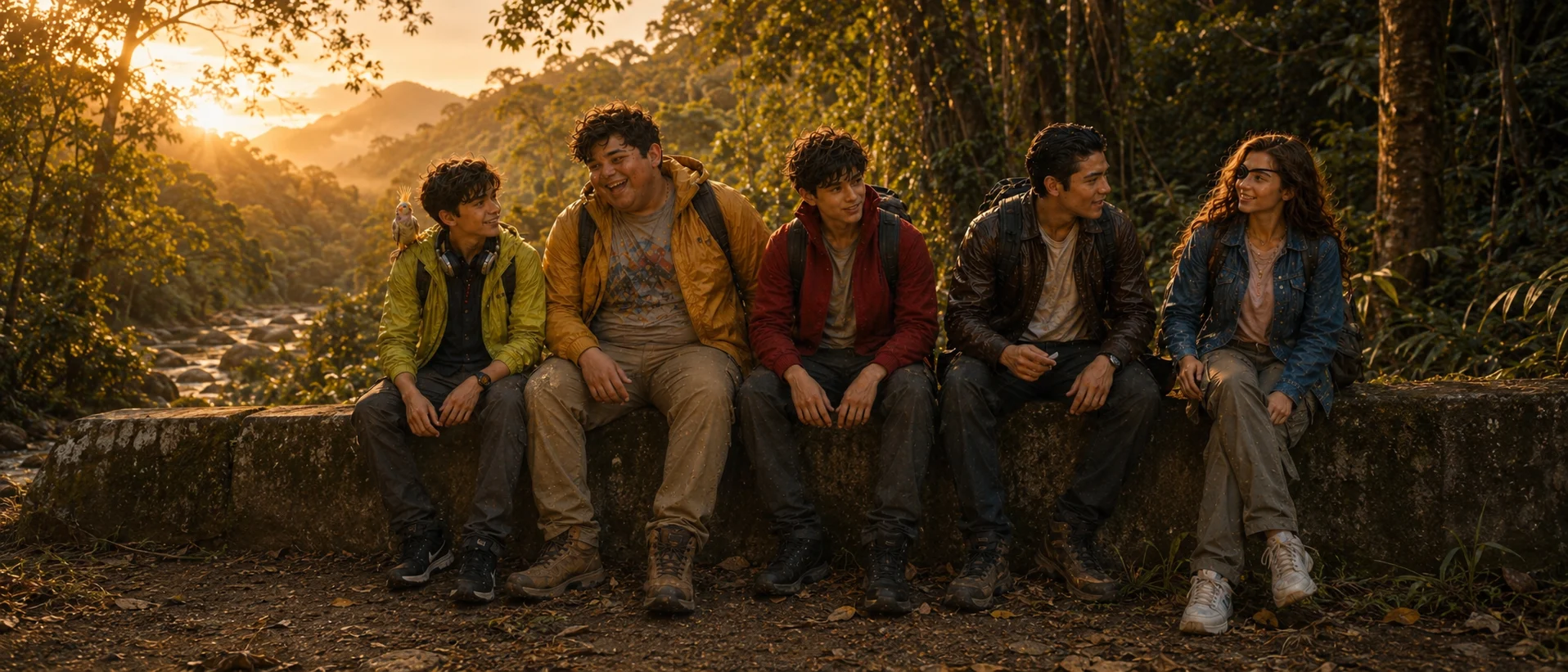
Footsteps thundered up the slope. Breathing like a steam engine, a silhouette of a giant came into the light, dragging his bicycle and muttering curses. His shoes were coated entirely in mud. His shirt clung to his round belly, already damp with sweat. Somehow, despite all visible misery, he was still eating roasted peanuts from a folded newspaper cone.
“Mud! Always mud. This is why people invented concrete.” The giant boy said, while lifting his shoe and inspecting it with theatrical disgust.
A peanut disappeared into his mouth.
He chewed thoughtfully, “I’m going to need therapy after this.”
“Divit!” Shouted Ritviz, “Did you finish all the snacks you were supposed to bring?”
Divit! So this was him. There was nothing visibly extraordinary about the boy. No glowing eyes. No terrifying aura. No cosmic grandeur leaking from his existence. Just a giant teen with a soft face. Yet… Somewhere ahead in time, this same boy would become something else entirely. Something impossible. The thought settled strangely inside me. Because transformations like that must crawl their way through suffering.Divit tossed another peanut into his mouth and panted, “Excuse me, it’s called foraging. Our ancestors did it. I’m being authentic.”
“Yes, authentically hopeless.” Muttered Enakshi.
Divit, still struggling to reach them in the mud, shouted, “LOUD! I can’t hear you, Ena.”
The girl shouted, “THE NAME IS ENAKSHI! HOW MANY TIMES DO I HAVE TO REMIND YOU OF THIS?”
Before Divit could reply, Ritviz asked, “Where are Rohit and Bikash?”
From behind Divit’s bulk, a small arm shot up, and a voice followed, “I’m here. I am behind the giant of our generation.”
Rohit sprang into view in a new spring-grass jacket. The sleeves were rolled past his wrists, but still threatened to swallow his hands. The shoulder seams fell off like tired flags. The jacket definitely belonged to someone taller and broader. A silver watch winked in the sun as he waved.
“Giant of our generation!” Divit stopped and turned back and said, “Pick a fight, you can win, grasshopper.”
Rohit replied, “Pick a fight where you don’t have to call sitting on your opponent a fatality move.”
Divit barked a laugh that startled a nearby crow and asked, “Why this jacket again? Do you ever wash it?”
“Look around, thick head!” Rohit swept his arm at the dripping trees and continued, “We’re in a jungle. This is camouflage.”
Divit raised a brow and said, “If that neon thing counts as camouflage, then the Earth’s flat and the sun revolves around it.”
Ritviz shouted, “Com’n guys! We’re already late.”
Divit jerked a thumb at Rohit. “Tell him! He’s the one who came late.”
Rohit said, “I was waiting for Bikash.”
Enakshi said quietly, “He ditched us again. What’s wrong with him?”
Ritviz replied, “Give him time. He’ll come around.”
Divit flopped and stretched out like a beached whale on the hill slope, limbs sprawling in every direction.
A deep groan escaped him, “Whoever said hill climbing burns calories is a liar. This is torture….”
The hill was barely fifteen feet high. Rohit stared at him in disbelief.
He flicked a pebble at him and said, “You ate half the jungle on the way. You’re not burning calories, you’re collecting them.”
Divit waved him off. “I’m sampling the terrain.”
Rohit, crouched by an anthill, said, “Yeah, National Geographic should hire you: Man, Who Eats Ecosystem.”
“Honestly, your metabolism…” Enakshi’s gaze shifted lazily toward Divit, “…and your foolishness…” then toward Rohit, “…deserve separate documentary series. Preferably narrated by David Attenborough,” she continued calmly, “so the world can mourn properly.”
Ritviz laughed under his breath. “Don’t join them, Ena.”
Rohit picked up a twig, poked the anthill, and grinned, “Yeah! Don’t join us, ENA!”
Divit’s coconut coloured eyes gleamed as he smirked, “Join Ritviz only, Ena!”
Enakshi froze. Completely. The forest itself seemed to recognise danger and fell silent accordingly. Her jaw tightened slowly. A vein pulsed visibly near her temple.
Ritviz took one careful step backwards.
Wise decision.
Enakshi inhaled once, “FOR THE LOVE OF GOD, IT’S ENAKSHI. NOT ENA!”
The sound tore the air open. A flock of parrots burst from a nearby tree, an explosion of green and scarlet against the pale morning light.
Ritviz said, “Com’n guys! Let’s go as we had planned.”
Divit said, “Why can’t we eat here? Why do we have to go deeper into the jungle? This place is perfect! Shade, the view, parrots performing live…what else do we want? Let’s open the lunch boxes.”
Ritviz exhaled through his nose, half a smile ghosting over his lips. “First of all, it’s too early for lunch. And second…” he gestured at the narrow trail winding deeper into the forest, dappled by light, “If we don’t explore, how will we ever know if there’s a better spot? We’d still be stuck by the main road if we hadn’t left it.”
Divit sat up and continued, “Men have spent thousands of years trying to leave jungles… They built walls, roofs, … Civilisation! … Remind me, why are we undoing all that progress? Why are we here voluntarily reversing our ancestors’ hard work?”
Enakshi’s shoulders eased, the fury melting into something steadier, sharper. “He’s right,”
Before letting Enakshi finish, Divit jumped in, “See! She agrees. Two against one. We win. Give me your lunch boxes… I will taste them for poison first.”
Rohit, who had been prodding the ground with his stick, piped up, “I haven’t voted yet.”
“Darwin’s rejected chapters are not eligible for voting!” Divit snapped.
Enakshi reached out, caught Divit by the ear, and twisted firmly enough to make him yelp and asked, “Will you let me finish?”
Divit cried, “Y…Ye…Yes! Yes!”
She continued, brushing dirt from her palms, “Ritviz is right. NOT YOU. The jungle hides its best places from lazy explorers.”
Divit groaned, “Then the jungle can keep them.”
Rohit grinned and swung his twig over his shoulder like a sword. “Adventure, ho!”
Divit rolled his eyes and said, “The grasshopper and the Capt. Monocular is leading the way! We’re DOOMED! Ain’t we, Kesar King?”
Ritviz asked, “Kesar king!”
“Yeah! Lean and always in red. What options do you have? Red Lantern!”
The banyan’s leaves rustled overhead, as though the forest itself were trying not to laugh.
As the sun climbs higher, they set off. Divit kept on muttering about mosquitoes, mud and all the things he could find, while Rohit hummed an off-key marching tune, Enakshi led with fierce confidence, and Ritviz trailed behind.
Rohit pointed toward the forest and said, “Let’s camp near the stream today. Bet it’s cold.”
Divit grunts, “Bet! It’s full of leeches.”
Rohit grins, “Bet! You’d eat one if it had sauce.”
I could not understand why I was seeing a bunch of teens. Where was Yaram, the meteor guy? Indeed, he was more interesting than this teenage theatre.
Then I heard Capt. Ramayaa’s voice again, “If you want to see him, just move the joystick thinking about him. Have him in your thoughts, and you’ll reach him right away.”
I raised my hands in protest, palms open, empty and yelled, “I DON’T HAVE A JOYSTICK, OLD MAN.”
He replied, “Yeah, your mind doesn’t possess physical objects. Your body does. Try to focus. It’s not very hard.”
The moment his name formed in my mind, everything shifted. Reality itself seemed to loosen. The ground beneath me disappeared into motion while I remained terrifyingly still at the centre of it all. Cities dissolved into ribbons of light. Oceans twisted into silver fractures. Mountains folded like cloth beneath invisible hands while rivers and highways stretched endlessly across the dark like veins beneath skin.
The Earth rolled beneath me in silence.
Faster. Faster. Then suddenly everything stopped. Cold air hit my lungs sharply.
Hunza Valley.
The difference was immediate. The air here felt thinner, cleaner, edged with pine resin and glacier dust. Snow-covered mountains stood in every direction like ancient white gods watching over the valley in silence. And there, perched near the edge of a rocky ledge, stood Rashul’s house.
Stone and mud walls bent slightly beneath decades of winter storms. Wooden beams protruded unevenly beneath the roofline. Wind-carved prayer flags fluttered weakly from one corner of the terrace, their faded colours barely surviving the mountain cold.
The house did not look lonely. It looked enduring, like something that had survived grief simply because survival had become a habit.
I moved closer slowly.
The backyard opened toward the valley below, where apricot trees leaned against old stone fencing, their leaves trembling beneath the afternoon wind.
Rashul sank into a worn armchair, facing the mountains.
Age had not arrived gently for him. Deep wrinkles cut across his face like dry riverbeds. His shoulders had collapsed inward beneath the weight of years. Sunken cheeks sharpened the outline of his skull while his fingers trembled faintly against the armrests beneath a woollen blanket.
Beside him rested Shera, breathing unevenly but peacefully.
The enormous ash-grey dog lay quietly, his muzzle pressed to the cold Earth, his cloudy eyes half-closed beneath the fading sunlight. Even sleeping, the old animal stayed pressed protectively close to Rashul’s chair.
The wind stirred softly through Shera’s fur. Neither moved for a while.
The sound of a distant pressure cooker grew louder with each passing moment.
It was Yaram hovering.
He moved towards Rashul, suspending several inches above the ground while silver light drifted slowly beneath his skin like submerged stars.
Shera lifted his head slowly at first, then immediately settled back onto the ground the moment he recognised him.
“Weaker, he has become,” Yaram said.
Rashul watched him quietly for a long time.
Then his voice softened as he replied, “Old. He’s getting old.”
Yaram looked indifferent.
Rashul chuckled under his breath, “You still hate death.”
“Seeing you decay, I hate.”
“No, you hate limits.”
Yaram leaned closer, energy rippling around him like heat over coals, and asked, “Heal you again, I can do, my child. Allow me.”
Rashul replied, smiling, “Death ain’t no weakness, ya’ fool-fallen-from-sky.” No matter who ya’ are, ya’ can’t heal death, no more. We’re dying…”
“Not true, that is,” Yaram said before he could finish, voice firm but almost pleading, “A long life for you, I can grant. It is the least I can do, my child. Allow me.”
Rashul’s gaze softened, moved to the distant peaks.
His voice came slow, along with a lone tear that traced down his cheek, “Nah, it’s ‘bout time. In ma’ long life, I’ve had fights an’ feasts. Faith an’ doubt. I’ve loved people. Buried people. Lost things I thought I couldn’t survive losin’.” His fingers moved absentmindedly through Shera’s fur, “But I’ve lived, lad. Fully.”
A lone tear slipped quietly down the side of his weathered face.
“Now, I’m ready to see wot comes after.”
For a moment, even the wind stopped to listen.
Yaram replied, “REQUAR RIS-OKI SALORYATA.”
(Embrace the freedom… Be free from this prison of death.)
Whether death is an eternal abyss of darkness, a fiery pit, or a clouded castle, we fear it.
Whether it comes as a relief or a surprise, we fear it.
Whether it comes at a young or old age, we fear it.
But why? Why do we fear death?
Maybe Rashul finally found the answer. Because sometimes fear fades only with the knowledge of its origin.
Rashul begged, “Ma’ life ain’t no cakewalk. Please smooth ma’ death, ma’ friend. Please.”
Yaram’s form flickered with light as he said, “Rest till eternity, also wants your loyal friend with a fifth flapping limb, you call a tail.”
Rashul bent down and took Shera into his lap. The dog licked his palm gently, as if he too understood.
Rashul told him, “Thank ya’ mate. Ya’ have been a family to me in ma’ worst days. I wish I could have done somethin’ for ya’.”
Yaram hovered his hands over them both, his energy swirling like a gentle wind. Then, something impossible happened, and Rashul heard Shera’s thoughts.
“I wish to be with you in death,” the dog said, in a voice that was more feeling than sound.
Rashul’s face crumpled, tears cutting clean tracks down his weathered cheeks. “Ah, Shera…”
Then Rashul and Shera looked at Yaram and burst into tears.
Yaram said, “As you wish, my children.”
Silver light spiralled outward around them, neither violent nor blinding. It moved like warm wind through tall grass.
Rashul and Shera’s bodies went still.
The pain that had once burned like a fire faded to an icy numbness. Black filled the edges of their visions, and they could only hear their own heartbeats.
For several long seconds, only two heartbeats remained.
Fragile. Slowing. Slower.
Then…
Silence.
Yaram stood over them, radiant and terrible, a being who could command the sky yet could not escape the stillness of death. Without moving his lips, he sent something outward.
The village heard him. Doors opened across the valley. People emerged slowly from homes and narrow roads, expressions already heavy with knowing.
By sunset, the entire village had gathered.
Old hunters carrying prayer beads. Women with trembling hands. Children clutching wildflowers. Each brought something small for Rashul.
A memory. A story. A goodbye. A favourite hymn to sing.
Struggling to hold back the grief, tears flow steadily and silently. Being bruised inside, they walked behind coffins to wave a last goodbye.
Rashul had touched every soul in that village, either through his works or by his stubborn kindness. He repaired roofs after storms in exchange for a cup of tea. He carried sick children through the snow when roads disappeared beneath winter. He sat beside grieving widows in silence because sometimes silence was kinder than advice. People trusted him with things they never trusted priests with.
But the greatest thing Rashul ever brought into their lives was not wisdom, nor protection, nor even compassion.
It was Yaram.
Twenty-four years have passed since he found Yaram. While others feared him, Rashul had offered shelter first and questions later. Over time, the village stopped seeing Yaram as an ugly monster from another world. He became their miracle. He healed fevers. Mended broken bones. Brought rain during droughts. Calmed storms with lifted hands. And somehow, through all of it, Rashul remained the only person who treated him less like a god and more like an unusually troublesome guest.
The funeral moved slowly through the mountain paths. No grand speeches. Only tears carried quietly behind lowered heads.
Yaram stood apart from everyone else.
Watching. Learning.
Amazed and disgusted concurrently.
He had never seen a funeral before, as no one had died since he arrived in that village. For him, death serves none. The dead could build nothing. Protect nothing. Love nothing. They became memory and matter. Nothing more.
He had seen entire civilisations die without ceremony. Entire planets had vanished beneath stellar fires while galaxies moved on, untouched by grief. Compared to that, two graves beneath a mountain sky meant nothing.
Less than nothing.
He had seen more deaths than the number of sunsets Earth had ever known.
Today should have been no different.
To Yaram, Rashul, and Shera’s passings were merely another leaf falling somewhere inside an endless forest.
Natural. Forgettable. Small.
Yet something about the humans unsettled him. They mourned as though the universe itself had been wounded personally. As though one old hunter and his ageing dog carried the weight of stars.
The irrationality of it disturbed him deeply.
And still…
He could not look away. Somehow, impossibly, one stubborn old hunter had managed to make an immortal being feel the weight of a single falling leaf.
His detachment, though soaked in indifference, carried a depth and complexity beyond my understanding. I think Yaram did not reject grief because he lacked emotion. He rejected it because existence had exhausted him beyond the point of mourning.
Then something shifted in Yaram’s expression.
Subtle. Sharp.
His silver eyes narrowed slightly as though hearing something impossibly distant.
The confusion vanished. Recognition replaced it. Then came the smile.
Small. Uneasy. Terrifying.
The air around him distorted instantly. Leaves lifted from the ground. Dust spiralled upward. Villagers stumbled backwards in alarm as gravity itself seemed to bend toward him.
Yaram slowly rose into the air above the graves.
His body began spinning. Slowly at first. Then faster.
Silver light exploded outward in widening rings while the wind screamed through the valley. Rocks trembled violently. Prayer flags snapped loose from their ropes.
The world warped around him.
Not magic. Something stranger. Physics surrendering.
The spinning accelerated until his body blurred into a column of white light twisting violently against the darkening sky.
Then everything collapsed inward.
Light. Wind. Sound. Reality itself.
All of it compressed suddenly into a single pinhole of light.
And with a sound like reality tearing paper-thin… Yaram disappeared.
For a long, stunned second, nobody moved; then a ripple of dropped hands and open mouths passed through the crowd like a small earthquake.
I blinked and Capt. Ramayaa’s voice was on me again, “Hurry! You’ll miss it. Go to Ritviz. Now. Go now!”
As soon as I forced the image of Ritviz into my mind, I was back again in the city of temples. The sun had already dipped below the horizon, and the streets were now awash in the violet hues of dusk. Yaram stood in the middle of a street, a calm figure amidst the panicked cries of the frightened kids. A gun was pointed at the back of Yaram’s cape, and the metallic smell of gunpowder filled the air as smoke poured from the burst barrel.
Then, cutting through the charged silence, came Capt. Ramayaa’s voice, commanding and impossibly close to my ear, “I’m taking you a few hours back. For that, I need to turn the joystick wheel. Hope you would not yell at me for touching you.”
The sun had already begun descending. The shadows huddled, short and thick, as if seeking refuge under the tree. The friends found shade near the forest stream. Looking around, I saw no path, not even a worn one, that could have guided them to that place. Tangled with roots, spiky vines and whispering grass everywhere. The forest was denser, wilder there. The green there felt ancient.
“How come we’ve never come this far?” asked Ritviz, half in wonder, half in disbelief.
Rohit, hopping over a fallen log, pointed at Divit, announced, “Because His Majesty starts hyperventilating whenever the road stops looking civilised.”
Divit said while fanning himself with a leaf, “Who needs enemies when you have humidity?” Wiping beads of sweat traced down his temples, he continued, “Honestly, even the mosquitoes look dehydrated here.”
Enakshi, stretched out on the blanket, one arm folded beneath her head. Sunlight filtered through the canopy above her, scattering into a mosaic of green and gold across her face. A soft hum left her lips, low and content, blending with the drone of cicadas and the liquid chirr of unseen birds. The song was old, older than the four of them.
Her hum seemed to reach Ritviz like sunlight through water. He tried to look away, but her humming pinned him gently. He was not looking at her the way a boy looks at a girl in a story; he looked at her the way someone studies a map. She caught him watching once, or maybe twice. Each time, he looked away too fast, as if the glance itself were a confession.
“Hey, Ritviz,” Divit said, squinting at his muddy bag, “Did you find a blue pencil?”
Ritviz froze. Amber eyes widened, yet his head felt heavy. Enakshi’s lazy hum faded. She sat up, her one blue eye glinting with a slow cat’s ear.
“Why does he need a blue pencil?” she asked, her tone light but her stare too steady.
Rohit’s eyes widened with scandalised delight. “There’s a blue pencil?”
Ritviz met Enakshi’s gaze for an instant, just long enough for the lie to show itself in his eyes before he looked away, pretending to adjust his bag strap. Enakshi’s blue eye, a cold sapphire, narrowed, trying to read something written not in his expression but in the way he did not meet her gaze. He felt the phantom touch of her stare on his shoulder. Silence pressed between them.
Divit grinned, chewing on the mystery like it was lunch. “What else? For sketching! His granny told my mom he’s been sketching a girl.”
“Ugh!--- Wh-What? I… No! … No! It was for the sky,” Ritviz said too quickly, the word sharp enough to betray him.
“Ain’t ya’ paintin’ a night sky?” asked Divit, suspicion draped across his grin.
Ritviz hesitated.
“Oh! Great arts have many layers,” he said, voice half-drowned in false nonchalance. “And when did you become an expert in painting, Divit?”
The attempt at levity hung crookedly in the air; it almost worked, until the sunlight betrayed him. A faint blush crept up his neck, gathering heat in his cheeks, the red blooming bright against the cool green of the forest. Enakshi caught it, of course, she did. Her visible eye narrowed slightly, not mockingly, but carefully. Like she was trying to solve him.
Divit chuckled, sensing the discomfort, “You’re terrible at secrets, man.”
Rohit, sitting apart near a puddle that reflected the half-healed sky, squinting at the ticking hand. “How does the watch know,” he muttered, “That it has to tick this much for a second?”
Before anyone could reply, the underbrush gave a sudden rustle.
Something wet slammed into Divit’s chest.
He screamed. Not a dignified scream. Not even a human scream.
It was the exact sound a kettle might make moments before exploding.
A bullfrog clung to his shirt. Another landed directly onto the picnic blanket with the confidence of a landlord returning home.
“WHAT IS WRONG WITH THIS FOREST?!” Divit yelped, flailing backwards in theatrical horror.
His arms windmilled, his legs kicked, and gravity did the rest. He landed flat in the mud with a splash that sent an arc of cold, sticky mud flying straight toward Enakshi.
“DIVIT!” she sputtered, wiping at her face, but the attempt only smeared it further.
Before she could stand, the ground beneath her betrayed her, too.
Ritviz lunged instinctively to catch her.
A terrible reflection.
His hand found hers, but momentum had already written its violent script.
Both of them crashed sideways into the shallow water.
For one dizzy second, Ritviz found himself half-submerged, staring directly into Enakshi’s face from inches away.
“I hate nature.” Divit said.
Rohit was no help at all. He was doubled over, hands on his stomach, laughter spilling from him in wild bursts.
“You---should’ve---seen---your faces!” he said between breaths, clutching his side.
The bullfrogs, their mission accomplished, hopped solemnly away toward the stream, leaving behind a battlefield of spilt food and wet laughter. And in that wild, ridiculous moment, the tension between Ritviz and Enakshi dissolved into something quieter but no less real.
Rohit, still hiccupping with laughter, pointed downhill and said, “There’s a stream,” he managed between breaths, “Down the hill--- we can wash before Divit starts growing mushrooms.”
Divit yelled, “This picnic is cursed. I am telling you.”
Rohit was already halfway down the slope, pushing Divit’s cycle, his green jacket flashing through the trees. “Come on! The water’s calling your names!”
The others followed, slipping and sliding on the damp trail. The forest seemed to open as they descended; ferns brushed against their legs, and the smell of wet Earth rose, sweet and heavy. The sound of the stream grew clearer; a trickle, then a rush, then the soft clatter of pebbles rolling beneath the current. The stream wound through a bed of smooth stones, its water crystal clear, reflecting the trembling green above. Dragonflies darted between the reeds, their wings flashing like tiny mirrors.
Divit plunged in first, splashing and sending arcs of water high into the air.
“Holy mother of seven!” he gasped. “This’s freezing!”
Then Ritviz noticed something strange.
Tracks.
Fresh impressions pressed into the mud beside the stream.
Dog prints. Large ones.
He crouched slowly.
Enakshi followed his gaze, her fingers tightening around her eyepatch’s strap. “What is that!” she murmured.
Ritviz brushed fingers lightly across the print and replied, “Someone brought dogs here.”
“Recently?” Rohit asked.
Before Ritviz could answer, a sound echoed through the trees.
Sharp. Pained. Animal.
“You heard that?” asked Rohit while collecting stones and pebbles from the riverbed.
Divit replied, “Parrot understands parrot! Congratulations! Now you can add this to your CV.”
Another cry came. Closer this time. Not a bark. A scream.
Rohit straightened first. “That’s a dog.”
Another yelp split the forest air.
Fear this time. Pain.
“Someone’s hurting it,” Ritviz shouted, the sound of his splashing feet already filling the air as he sprinted through the stream.
Divit stumbled after him, half protesting, half protective.
Branches whipped against his arms as he sprinted through the undergrowth. The others crashed after them through the ankle-deep water, hanging vines, and the scratchy bite of sharp grass. Rohit still clutched a handful of smooth pebbles, though a dozen had already scattered behind him, flicking into the mud like lost teeth.
Then they saw it.
Two older boys stood ahead, their shadows stretching, casting a dark shape over a dog, a scarred mongrel whose ribs were visible under the patchy fur of blood and mud and a tail tucked low. They had chained it.
A stone whistled, followed by the thud of a stick. The louder it cried, the more biting it was getting. Its incapability was, somehow, giving them pleasure. Blood stained its fur as the dog looked tired and hungry. Then one of them lifted a heavy boulder over his head, the sound of his breath audible as he prepared to throw it with deadly intent at the injured dog.
Ritviz’s fingers balled into a fist, and his face blazed crimson before he shouted, “HEY! STOP!!”
Rohit yells too, “Leave it alone!” throwing a stone that misses by a mile.
The sudden jump startled the boy with the boulder. His hands, slick with sweat, slipped, and the rock he had hoisted over his head plummeted on his face. A sickening crack echoed. His nose flattened under the boulder. Four teeth soaked in blood tumbled, skittering across the cold, muddy ground. The taste of his own blood might not be new to him, but the sting of embarrassment was definitely fresh.
For one stunned heartbeat, everyone stared.
“JUSTICE!” whispered Divit.
Ritviz charged forward. Divit steps behind Ritviz, eyes wide, unsure whether to stop him or follow.
The other boy pulled a knife.
Enakshi grabbed a stone from Rohit’s pebble pile. She was ready, arm cocked to throw.
Rohit yelled, “Hey! That’s mine.”
An unexpected voice came from Ritviz. He stepped forward, hands open, arms spread.
No weapon, no anger.
In a tone that seemed to borrow its gentleness from the pauses between cuckoo calls, he said: “I’m sorry. That was never my intention. We just need you to let the dog go.”
The wounded boy stood up with a wave of anger boiling behind those tear-filled eyes. Blood coursed down from his nose and mouth, wetting the ground.
The wounded boy screamed through blood, “MA’ BROTHER’S GONNA KILL YA’!”
Divit pointed at his broken teeth. “Please pronounce your threats more clearly.”
Rohit gave a hearty laugh, and so did Enakshi.
“Laugh while ya’ can, rats!” The boy with the knife replied in a hateful voice.
“Ya’ gotta do wot ya’ gotta do,” replied Rohit, while throwing pebbles at them, “And we gotta do what we gotta do.”
Eventually, the boys retreated back into the trees; one limping and one swearing.
Silence returned slowly.
The dog still lay there, ribs heaving, eyes wide and shining with the kind of terror that could make even pity dangerous. A thin chain, rusted and cruel, dug into the raw skin of its neck.
Divit sat back on his heels, breathing like a drum. Rohit crouched nearby, meticulously counting his pebbles, nodding to himself as though the world had been saved by his modest arsenal.
Enakshi stepped closer, her one blue eye fixed on the trembling creature.
“Easy, girl!” she murmured.
The animal tried to shrink away, ribs pressing against skin, teeth flashing in a weary snarl. Its eyes darted between her and the trees.
She turned slightly, her voice low but firm. “Divit, do you have something?”
Divit blinked, half lost in his own pulse. “What?”
“Something for it to eat.”
Divit rummaged through his pockets and produced a crushed biscuit with the pride of a magician revealing treasure.
Enakshi took it gently.
She knelt. Held it out slowly.
The dog’s growl deepened; low, guttural, desperate. Its teeth flashed white against the mud. The dog’s ears flicked back; its body trembled so hard the chain rattled.
Ritviz shouted, “STOP ENA!”
Too late.
A flash of motion. The dog lunged, teeth snapping in blind panic.
Enakshi pulled her hand lightning fast.
Ritviz sank to his knees beside the dog and whispered, looking into the dog’s eyes, “You’re safe now!”
Something strange happened then.
The dog stilled as though she understood.
Its growl weakened. Its trembling eased like a storm running out of wind. Its frightened eyes locked onto Ritviz’s amber gaze. And slowly, impossibly slowly, it lowered its head.
Ritviz reached forward and unhooked the chain; metal slipped free with a faint click.
The dog limped free.
Then, to everyone’s shock, it walked directly toward Enakshi and gently pressed its muzzle against her palm and licked.
An apology. Quiet and trembling.
“How did you do that?” Enakshi whispered.
Her voice was part wonder, part disbelief. Rohit and Divit exchanged wide glances, their confusion loud enough to fill the silence.
Ritviz looked genuinely confused himself, “I… don’t know.”
Then came voices from deeper within the trees.
Not hostile. Measured.
Figures emerged from the trees so quietly that, for one sharp heartbeat, they looked less like people and more like the forest deciding to grow human faces.
There were three of them: two men and a woman. Their skin carried the bronze burnish of mountain suns. Feathers and beads hung around their necks, but their clothing confused the eye. Worn jeans. Old sneakers. A faded hoodie stitched with tribal patterns. Ancient and modern stitched awkwardly together like two centuries forced into conversation.
Rohit reacted first.
Naturally.
Rohit sprung up with his pebble pile clenched like a weapon. “Stay back, brother in feather!”
Divit stared at him. “Brother, that’s a pebble.”
The oldest among the strangers raised both hands calmly. “Peace.”
“We saw what you did. We can’t thank you enough.” The woman said.
Her voice carried the stillness of old rivers.
The injured dog whimpered softly and limped toward them. Immediately, the woman crouched beside it with practised gentleness.
“She belongs to us,” the tall man explained.
Ritviz’s jaw tightened slightly. “Belongs?”
The word came out heavier than intended. The man studied him carefully.
“Yes.”
Ritviz glanced at the rusted chain still hanging from the dog’s neck. Blood had dried beneath the collar in dark flakes. Something restless flickered behind his amber eyes.
“That sounds more like ownership than care.” Ritviz said.
Pressing his index finger against his lips, Divit whispered, “They’ve bows! Keep quiet, lad!”
The tribal man rested one hand against the dog’s trembling back. “We feed them. Hunt with them. Protect them. They sleep beside our fires.”
“And if they want to leave?” Ritviz asked.
The woman finally looked up from the dog’s wounds. “Leave for where?”
“The forest.”
“The forest kills.”
Ritviz shook his head slowly. “So does captivity.”
A silence settled between them. Not anger. Not comfort either.
The tribal leader exhaled softly through his nose and said, “You speak like a child who has never lived among beasts.”
Ritviz did not flinch and replied, “And you speak like fear deserves obedience.”
Divit muttered quietly, “Excellent. We’re definitely getting sacrificed.”
Nobody listened.
The man crouched beside the dog now.
“She came to us half-dead during many winters back. One eye was infected. Three ribs broken. We healed her. Fed her. Stayed awake through the nights so she would not die shivering. Tell me, boy… isn’t that care?”
Ritviz paused because part of him understood, but another part rebelled anyway.
“That still doesn’t give us the right to decide their lives for them.”
“A creature left to die in the wild… is that freedom, or neglect?” asked the woman.
Ritviz replied, “Maybe freedom is not about care but the presence of choice. The right to walk away, even from love.”
“What do you know of love, kid!”
Ritviz’s eyes burned with a strange conviction.
But before he could speak, the older man looked up and said, “Our dogs are our kin and tools. We bind to survive. We serve each other. We protect each other. To us, belonging is safety, and safety is shared. That’s balance, not dominance.”
“Then how come she wears a collar, but none of you does?”
Enakshi added, “We chain what we fear to lose, not what we love.”
For a moment, they simply stood; two versions of care. Neither converted the other. The disagreement remained honest and moral, but did not divide them.
Yes, freedom means risk. Freedom is the cost of living. A bird in a cage is safe from hawks, hunger, and storms; yet its safety is purchased with its sky. Freedom is the opposite bargain: you get the sky, but you also get the hawks. Justification of confinement in the name of concern while normalising domination is a crime. This makes other violence easier to commit. This habit of thought, in which humans are proprietors and animals are property, should be abolished.“This chain,” the older man said quietly, lifting the rusted collar, “was not ours.”
The atmosphere changed immediately. Even the birds seemed to hush.
“What do you mean?” Enakshi asked.
The woman stood slowly. “She disappeared three nights ago.”
Another man among them spat bitterly into the mud. “Hunters.”
“Not hunters,” the leader corrected coldly. “Traders.”
The word carried disgust sharp enough to cut.
Ritviz straightened, “What traders?”
The man pointed deeper into the forest, “There are people who sell living things.”
Rohit blinked. “Like… pets?”
“Like objects,” the woman’s eyes hardened as she continued, “They steal puppies. Birds. Snakes. Turtles. Frogs.”
“What do they sell frogs by? By how high they jump or how loud they croak?” Rohit muttered with an unguarded curiosity that made his questions sound like riddles, and added, “And snakes? By length, or venom?”
“Anything breathing becomes money, kid.”
The leader nodded once toward the wounded dog, “We think she escaped last night. But not her puppies.”
Silence crashed over the group. The stream suddenly sounded louder. Somewhere distant, a crow cried once.
Ritviz’s fingers curled slowly into fists. “How many puppies?”
“Four.”
“Who took her puppies?” Enakshi and Ritviz asked at once, their voices overlapping; her sharp with outrage, his low with disbelief.
Divit’s round face twisted with fury, and he asked, “Those kids we just scared off… they did that, didn’t they? The same brats who were beating the dog!”
“Men,” the taller man said. “From the edge of the town. They come on motorcycles when the moon is thin.”
The leader pointed toward the deeper trail, where the muddy ground showed faint, non-animal tread marks. “That way. Beyond the mango grove, where the river bends. You will see a tin roof covered in a tarpaulin sheet and cages stacked on cages stacked higher than a man’s head. There is a pet shop.”
Divit spat into the mud and said, “Calling that a shop is like calling a graveyard a garden.”
Ritviz took a deep breath but then straightened his posture and said, “If there’s a pet shop torturing animals, then we’re shutting it down today.”
The older man studied the teens for a long moment. Perhaps measuring foolishness. Perhaps courage. Sometimes the two looked identical.
“You are brave children,” The older man said eventually, “Bravery without caution feeds graves.”
Enakshi added, “Yes, not today, Ritviz!”
Ritviz asked, “Why not!”
“By the time we reach the shop, it’ll be night. And we don’t know the place. The escape routes. We don’t have a plan. And…” said Enakshi.
Divit added, “Besides, we can’t do that on an empty stomach.”
The tribal woman gave the kids round breads, glistening golden, sticky with honey and speckled with grain.
Divit snatched the entire packet, and he murmured, “Oh-ho! Divine! This is like… sunlight melted on a spoon.”
The tribal men chuckled softly as they said monotonously, “Forest feeds the best.”
Rohit responded, “The best… or the beast.”
The older man said, “Let’s show you a way out.”
Divit asked, “Is there a shortcut?”
“Apparently, there is. Follow us.”
The forest had already swallowed the last of the sun. Though it was only dusk, the canopy loomed so thick that the world below had fallen into shadow. Owls called from unseen places. Fireflies blinked in the underbrush. Lanterns flickered to life; soft orange globes swaying in the tribal men’s hands, halos of warmth in a sea of dark green. The boys rolled their cycles down the dry, muddy track, wheels crunching over roots and wet leaves, the glow of the lanterns bobbing like captive fireflies leading them onward.
The tribal men lifted their lanterns one last time, the flames painting their faces in amber. “You go,” one of them said. “The road beyond is yours.”
Divit asked them, “Do you have any of those breads? For the road. We have a long way home.”
“If you hear whistles in the trees,” the taller man said quietly, “do not answer them.”
Rohit looked horrified immediately. “Why would you say that right before we leave?”
Divit shrugged, mounting his bicycle, “I asked for bread, not dread.”
Ritviz hesitated. “Will we see you again?”
The man’s expression became unreadable beneath the lantern light.
“The forest decides such things.”
Enakshi turned to thank them properly. But the tribal people were already walking away. Lantern lights drifted deeper between the trees. Then vanished entirely.
The forest path wound through dark undergrowth while cicadas screamed from every direction. Branches clawed occasionally at sleeves and shoulders as if the jungle disliked being abandoned.
“Then hop on, one-eyed wonder! I’ve got enough space for both of us,” Divit said with mock chivalry.
Rohit’s voice came from behind, loud and dramatic as always. “What about me? I don’t even have a cycle!”
“Just because I’m a girl! You think I need chivalry!” asked Enakshi.
“No! Just because you have one eye, it’s dark, and it’s safer this way.” Replied Divit.
Enakshi hesitantly sat in the back seat.
Ritviz replied in a firm, but tinged with fond exasperation, “Rohit, you take Enakshi’s. She’ll ride with Divit.”
Rohit stared at the pink-tinted frame and the floral seat cover, aghast. “But that’s a girl’s cycle!”
Without missing a beat, Divit rolled forward. “Hop on! Or we’re leaving you here with the owls and ghosts.”
“That’s bullying and blackmailing all at once!” Rohit protested as he mounted the cycle.
Rohit picked up a pebble and mimed throwing it. “Keep talking, dumpling. You’ll be the first course when the jungle’s hungry.”
“Stop it, you two.” Ritviz’s voice was steady but distant, his eyes scanning the darkening tree line, “We should at least see that shop first.”
Divit groaned instantly. “Of course we should. Because surviving one disaster today wasn’t ambitious enough.”
“We’ll just scout,” Ritviz said, “Besides, it’s on the way.”
“Famous last words.”
Rohit stood on the pedals dramatically and said, “History shall remember us as heroes.”
“History won’t remember you at all if you break my cycle,” Enakshi replied.
And so, they pedalled on. Above them, the sky was a bruise of violet and blue, thinning into night.
Capt. Ramayaa’s voice said, “Scroll ahead in time till they reach the pet shop.”
The world reeled forward like a faulty film reel. Everything fast-forwarded, and then, with a jerk, the scene snapped back to a halt.
There they were. Standing before the shop.
A crooked wooden structure draped in moss and tarpaulin stood where the jungle met the forgotten road. Tin roof. Plastic sheets flapping weakly in the evening wind. Cages stacked everywhere. Shapes moving inside them. Whining. Fluttering. Scratching. A flickering signboard hung above the entrance. It read: ‘MERLIN’s NEST’, with the ‘S’ blinked weakly, turning the name briefly into: ‘MERLIN’s NET’, a slip of irony that felt truer than the name itself.
Rohit was the first to speak, his voice low. “This place looks… cursed.”
Ritviz was the first to dismount. His gaze swept over the row upon row of cages stacked meticulously like bricks against the damp, moss-covered walls.
Birds of every colour fluttered in cramped wire boxes; A monkey curled around its knees in a wooden crate, rocking as though praying to an absent god; Fish circled in jam jars barely wide enough to turn; puppies stuffed in cages where barely two could fit; kittens mewled in buckets; snakes coiled in boredom. Every cage was a verse in a poem about captivity. Two grimy glass windows on either side of the front door did not reveal much of the inside, except that a weak yellow bulb buzzed faintly above the counter.
Then came the sound.
Engines.
Several of them. Headlights cut through the jungle darkness from behind the shop.
The teens dropped lower instantly.
Motorcycles rolled into the clearing one after another like predators returning home.
And among them—
Rohit’s eyes widened first, “No way…”
A familiar figure climbed off one of the bikes. Dove-grey eyes. Slicked back black hair. Brown leather jacket. bulky backpack. A faint scar, fresh and red, marked his temple; a wound that did not look like it came from play.
Divit stared in disbelief, “What the hell! What are you doing here, Bikash?”
Bikash did not wave. Did not smile. His face was pale. His chest rose and fell too quickly. The once boyish charm was buried under a layer of fear and sleepless nights. His eyes met Enakshi’s, pleading for something she could not yet name.
A tall man climbed off the largest motorcycle. Heavy boots. Broad shoulders. Leather jacket despite the humidity. He looked like the kind of man who had forgotten how to smile without cruelty attached to it.
The two boys, they met earlier in the jungle, ran out of the shop.
Divit said, “We don’t want any trouble, man! That was an accident.”
The tall man tilted his head, studying him like a snake might study a frog, and said, “Well! I know. I just want you to say sorry to ma’ little brother an’ his friend an’ then ya’ can go.”
The boy with the patched nose sneered, his voice nasally and full of hate. “Ya’ can’t just let ’em walk away! Teach ’em a lesson.”
The tall man’s hand shot out, grabbing his brother’s ear. “Ya’ ain’t ma boss, rat. Don’t tell me wha’ to do.” Then, turning back to the kids, he said evenly, “Com’n! One by one, say sorry an’ walk.”
Ritviz stepped forward, his amber eyes reflecting the pale flicker of the pet shop’s dying bulb. “Look! Your brother and his friend were…”
The man interrupted, “I ain’t ask for no history lesson, boy.”
Enakshi took a sharp step forward, her one visible eye blazing and snapped, “WE ARE NOT APOLOGIZING FOR DOING THE RIGHT THING.”
While Enakshi was shouting, Divit was continuously tugging her t-shirt.
After she had finished talking, Divit murmured, “And here, Titanic hit the iceberg.”
One of the goons responded, “LOOK! LOOK! Is this the one-eyed alpha o’ pack of betas?”
Rohit elbowed Divit. “Com’n man! Look at your size. You could flatten them like chapatis. Go smash them, Hulk.”
Divit whispered back, “Hulk! This is only bulk, grasshopper.”
Ritviz stood taller, his voice steady but low, “Yes, we can’t be sorry for doing something right.”
Bikash stepped out of the shadow, his face half-hidden beneath the dim orange glow and said, “Let me talk to them once.”
The tallest goon tilted his head. “Ya’ know ‘em, lad? Then be quick. I ain’t got all nigh’.”
Bikash went closer, his voice dropping, “Don’t be stupid. You can’t win this.”
While Divit tried to cover Rohit’s mouth, Rohit muffled, “We can! We can. WE’VE DIVIT.”
Enakshi crossed her arms. “You know us, Bikash. We won’t apologise for the truth.”
Ritviz looked at Bikash, really looked at him, “Bikash! If you don’t want to hang with us anymore, fine. But don’t take their side. You’re better than this.”
Bikash’s jaw clenched. “I’m on their side!?”
“Then, why do you ask us to apologise?” Ritviz said quietly, reaching out to put a hand on his shoulder.
Bikash shook his hand off, his voice cracking, “Stop it. You don’t understand… They’ve got a loaded gun.”
That word, gun, froze the air. Even the cicadas outside the road’s edge seemed to hold their breath.
Divit and Rohit exchanged a look of pure terror.
“I don’t wanna die,” they said in unison.
Divit continued, “Forget about a slingshot. I didn’t even bring courage to the gunfight.”
“If you guys are scared, go. Beg him. I’ll stand my ground ALONE if I have to,” Ritviz said, his trembling voice betraying the courage in his words.
Divit swallowed hard and said, “Look, I don’t want to die young and hungry, okay? If we live today, we can fight tomorrow. Let’s just say sorry. We don’t really have to mean it.”
The tall man’s voice boomed through the night. “I’m losin’ ma’ patience!”
Bikash shouted back, “Just a minute!”
Enakshi stepped forward, her shadow cutting through the headlights’ glow, “I’M NOT AFRAID OF YOU!” she shouted.
“Well! You should.” One of the goons said.
They began to advance, dragging their bats, stomping against the ground. In the grip of silent panic, pupils dilated, hearts raced, and brains caught fire. It was hard to say if fear froze those kids or if bravery made them stand their ground. Their legs trembled, their hearts raced, but they stood.
Bikash exhaled, muttering, “A bunch of stubborn asses.”
He stepped forward, standing shoulder to shoulder with Ritviz.
The tall man glared. “Have ya’ gone mad, lad? Step aside!”
Bikash’s voice cracked, but he stood firm. “I won’t. You’ll have to go through me first.”
A bat swung toward him, but Ritviz caught it mid-air, the wood splintering against his palms.
A punch followed. Sharp. Brutal. Landing square on Ritviz’s nose.
He fell hard, the ground swallowing the sound of his breath.
Enakshi dropped to her knees beside him, pressing her napkin to the bleeding nose.
A vein on her forehead thundered. The sapphire eye caught fire. The world narrowed to the blood on her hand. Then she rose, slow, shaking, unstoppable, and stepped forward, nostrils flaring.
Looking at her rage, the tall man said, “I like her!”
Ritviz stood up, blood-soaked napkin still jammed up his nose, face flushed with anger and disbelief. He dragged Enakshi gently back, placing himself between her and the goons. His voice trembled, not with fear but restraint.
“I was the one who broke your brother’s teeth,” he said, holding the air steady. “And now you’ve broken my nose. We’re even.”
Before he could finish, a punch came flying from the side.
Ritviz’s head snapped to the right, and he fell down again, palms scraping the gravel.
“It’s not over,” the tall goon growled, shaking the pain out of his fist. “Not until ya’ apologise to ma’ brother.”
Enakshi snapped, “WHAT DO YOU THINK OF YOURSELF! YOU GOOD-FOR-NOTHING-BURDEN-ON-EARTH? BEATING UNARMED KIDS DOESN’T MAKE YOU POWERFUL. IT MAKES YOU A COWARD.”
The oldest goon’s smirk curdled. “An’ ya’ think you’re the bravest just because ya’ wear that eyepatch? Ya’ ain’t nothin’ but a skeleton with a scar face. Go scare the crows.”
A laughter broke out among the goons.
“Enough!” Bikash shouted, stepping between them, his voice heavy with authority. “He broke your brother’s teeth… You broke his nose. That’s the end of it. Let’s not stretch it.”
Enakshi’s shoulders rose like a wave ready to break. “YEAH! GO, YOU BUNCH OF ROTTEN COWARDS!”
Rohit tugged at her wrist, his voice shaking. “Ena… stooop!”
Divit muttered behind them, “Don’t fan the flame, Enakshi. Please.”
The goon’s eyes bulged. He jabbed his finger at her, spit flying as he screamed, “SHUT UP, YA’ BITCH! OR I’LL SMASH YA’ INTO THE GROUND!”
Pushing Enakshi back, Bikash said, “Look, she is just a girl. She doesn’t even understand the gravity of the situation. Please ignore her.”
“I’M NOT AFRAID OF HIM!” Enakshi roared from the back, “HE’S JUST A BIG, THICK COWARD, NOTHING ELSE!”
The goon’s patience snapped.
With a guttural growl, he lunged forward.
Pushed Bikash away like a fly.
Hand raised high to strike Enakshi.
And then…
Time stuttered.
The world slowed to syrup. Everything froze mid-motion. Dust hung in the air like suspended stars. Every sound turned deep and distant, like echoes through water. The forest, the bikes, the faces, all still. Only one thing moved.
Ritviz.
His fingers coiled like a storm gathering purpose. He rose from the dirt, every muscle burning, every breath a storm. His amber eyes shimmered with something beyond rage; something ancient, electric. Sparks seemed to race along his veins, crackling just beneath his skin. He lunged forward, fist cutting the air, leaving a faint trail of light.
The moment the punch landed, time snapped back. The man’s body lifted off the ground, legs dangling like a kite’s tail, and then crashed into the ground meters away. Blood streamed from his mouth and nose as he rolled, gasping for air.
For a heartbeat, no one moved.
Wide-eyed Ritviz looked down at his hands, trembling. His broken nose was gone. His skin glowed faintly. He looked human, and yet… not entirely. His friends stared, wide-eyed, struggling to process what they had just witnessed.
“What… just happened?” whispered Divit.
“How! How did you do that!” asked Rohit.
While everyone was trying to understand what just happened, Enakshi moved with a wild plan flashing behind her single blue eye. She sprinted to the nearest motorbike and shoved it with all her strength. The first toppled with a metallic crash, hitting another, and another; a perfect circle of falling dominoes. Gasoline spilt, headlights flickered and died.
“RUN!” she screamed.
Rohit did not need telling twice. He vanished with a scream on Enakshi’s cycle. With Enakshi on the back, Divit got on his cycle as gracefully as a startled elephant. And Bikash, torn between both worlds, jumped onto Ritviz’s carrier seat, facing backwards.
The first few meters were chaos: loose gravel, adrenaline, shouts, the smell of gasoline. Behind them, chaos erupted: curses, boots thudding, engines struggling to start. They raced down the jungle path, the night blurring around them; branches whipping, headlights streaking through the mist.
Behind them came shouting. Boots thudded. Engines coughed alive one after another.
Then the roar began.
Closer. Too close.
“They’re following us!” Rohit yelled.
“No,” Divit panted. “They’re hosting a parade!”
Bikash swung his bag forward with one hand. Something cylindrical clattered inside.
Divit stared and asked between paddling and breathing, “…Are those fireworks?”
“You’ve got to be kidding me,” Rohit panted.
Bikash grinned grimly. “Desperate times, brother.”
“Bikash.” Ritviz’s voice cracked against the wind. “Tell me you know what you’re doing.”
“Absolutely not.”
The lighter sparked.
A rocket hissed awake.
For one heartbeat, Bikash held a screaming comet between his fingers.
Then he launched it.
The rocket tore through the dark jungle like a silver spear. Smoke spiralled behind it, sharp with sulphur and burnt paper. It sped towards the headlights like a comet with bad intentions. For a breathless second, it looked too small, too foolish, a spark daring the jaws of the night to snap shut.
Then the sky burst open, raining down fiery debris of a celestial cough.
Silver light exploded outward, branching and multiplying like a silent, shimmering waterfall. Each strand hissed as it fell, dripping molten brightness onto the road below.
The headlights vanished beneath the silver rain. Tires screeched.
One motorcycle spun sideways as if it had suddenly remembered a different road, its headlamp spinning wildly before smashing into the dirt, its rider flung off, arms windmilling.
The forest flashed white, then ghostly blue, then back to black again. The darkness retreated as if sensing a threat. Shadows scattered like startled animals.
The teens looked back with wide eyes, open mouths, breath caught halfway between fear and laughter. For one impossible second, they were not running. They were witnessing.
Divit shouted from his own cycle, eyes wide, “Now, that’s wha’ we were missin’!”
Rohit whooped, the sound half-terror, half-exhilaration.
While paddling, Divit waved back and shouted, “GOODBYE! SEE YA’ NEVER.”
Then the silver rain thinned and darkness rushed back in, offended, impatient.
And the engines returned with it. Louder. Closer.
Bikash lit another rocket.
This one flew lower. Too low.
The firework streaked directly into the middle of the pursuing bikes and exploded with a violent crack. It cracked open the dark like an egg, spilling fire and smoke in all directions.
Metal screamed. Men shouted. Tires screeched.
A few bikers fell.
The air smelled of smoke and burnt powder, and the world looked like a battlefield.
“Enough!” Ritviz shouted, “Traffic ahead!”
The jungle path suddenly emptied onto a crowded road blazing with sodium lights.
Noise swallowed them whole.
Cars. Trucks. Horns. Shouting.
For a breathless moment, the city felt loud enough, crowded enough, alive enough to hide them. For a moment, hope returned.
The teens darted between vehicles and shot into the narrow shortcut leading toward home.
And the city disappeared. The lane was dark.
Silent. Too silent.
Then came the sound.
“Vrrrmmm!”
Headlights bloomed at the mouth of the lane.
One. Then three. Then six.
Motorcycles surged from side streets and broken lanes, sealing every exit with terrifying precision.
Ritviz slammed the brakes.
Gravel sprayed across the road.
The group skidded to a stop.
Dust drifted slowly through the beam of the headlights.
Figures climbed off their bikes.
Still half a dozen of them.
One man stepped forward while cocking a pistol. The metallic click sliced through the night.
Divit stared at the gun and said in a voice dry as dust, “Turns out fireworks are not a universal sign for ‘goodbye.’”
“They followed us, man!” Rohit said, stating the obvious like a prayer that might undo it.
Divit huffed a breathless laugh, “Followed? Please! We invited them with fireworks and moral lectures.”
Boots hit the ground, heavy and deliberate.
No anger. No rush. Only the calm certainty of someone who had ended lives before.
“Thought you’d disappear into the light, didn’t ya?”
The words struck Ritviz like ice water.
Something ancient moved inside him.
Not memory. Not exactly.
A sensation. An echo.
An ending he had once survived but had forgotten.
The past hovered just beyond comprehension; close enough to bruise, far enough to deny him clarity. Ritviz stood there, awestruck and undone, caught between a memory that refused to return and a present that suddenly felt like a repetition.
A pure déjà vu.
The gunman tilted his head.
“Well, that’s new,” he said, “Most people run, faint, urinate and even beg. But never seen someone zone out. I guess fear is a spectrum.”
The pistol raised. Its dark mouth aligned with Ritviz’s forehead, ready to devour his life.
Enakshi moved first, screaming, “NO!”
She lunged forward, blue eye blazing. Rohit stumbled after her. Divit charged too, shouting Ritviz’s name. Bikash grabbed for the gunman’s arm.
They never reached him.
The bikers intercepted them instantly with rough, practised, and merciless hands.
Hands seized collars. Hair. Wrists.
Enakshi fought like something feral, kicking and elbowing wildly until a man dragged her backwards by the hair. Rohit slammed against a wall hard enough to knock the air from his lungs. Bikash folded after taking an elbow directly into his ribs. Divit struggled hardest. Three men forced him onto his knees. Still, he spat upward between ragged breaths.
The world outside was chaos, yet Ritviz stood rooted, eyes unfocused, as if staring through the night into a depth with no bottom. For a fleeting, dangerous second, death did not scare him.
The finger tightened on the trigger.
The shot was fired.
Yet, before the bullet could exit the barrel, time mysteriously fractured.
The muzzle flash froze midair. The smoke, coiled in lazy spirals, hung mid-air like a Van Gogh painting. Dust hung motionless. Even sound seemed to tear apart.
Then light appeared.
Not bright. Heavy. Ancient.
A single point formed between the gun and Ritviz.
The distance between the barrel and Ritviz steadily began to stretch, as if the invisible fabric were being pulled apart by cosmic hands.
The few inches between barrel and target unfolded into an impossible distance.
And from that wound in space, light began to bleed.
Blue-white at first. Then silver. Then, colours no human language had ever bothered naming.
The air bent around it.
From the brilliance, Yaram emerged.
Weightless feet hovered inches above the road. A black cape hung perfectly still despite the wind. Silver eyes glowed with impossible calm. His form shimmered, edges soft and sharp at once, as if reality was still deciding how to draw him.
He stood between the gun and Ritviz.
Facing only Ritviz.
As if nothing else in existence mattered.
The wound in space sealed shut behind him.
And only then, smoke finally remembered how to move.
And the gun screamed.
The blocked barrel burst like fruit under pressure, sending fire and metal tearing backwards, chewing through steel and flesh alike. The gunman’s scream tore through the alley as blood sprayed across the asphalt. He collapsed to his knees, clutching what remained of his hand.
Men who had laughed moments ago now stumbled over each other, eyes blown wide, mouths working uselessly around prayers they had not spoken since childhood.
The light dimmed, but not the shock.
Silence followed. Fragile. Unsteady.
The teens gawked, trembling, pale, their minds flooded with questions
Enakshi’s breath hitched in her throat. Her good eye was wide, unblinking, drinking in every impossible detail. Fear sat sharp in her chest, but beneath it burned something stubborn and defiant. She dragged herself in front of Ritviz before even realising what she was doing.
Her breathing shook. Still, she stood there.
Protective. Terrified.
“Who are you?” she demanded.
Not trembling. Not pleading. Demanding.
Yaram hovered without disturbing the dust, black cape trailing like liquid moonlight. The light around him dimmed just enough for his outline to settle into something the eyes could tolerate, though not understand. He turned his head slightly, as if listening to something the others could not hear.
Bikash pressed one arm against his ribs while staring carefully at the stranger. He studied Yaram the way one studies a loaded weapon.
“This… this isn’t possible,” he whispered. “This is a trick. This has to be a trick.”
Divit failed to do what he always did when terror and disbelief shook hands. A laugh escaped, sharp and wrong. His sarcasm deserted him. His mind bounced between questions: Was this some kind of weapon? A projection? A government thing? An alien? A god?
Rohit crawled backwards until his spine hit the wall.
“Did you see that?” he whispered rapidly. “Did everyone see that? The bullet exploded. Bullets aren’t supposed to explode.”
The goons did not run immediately. Terror like this does not work that way. First comes the stillness. Then one man stumbled backwards, tripped over his own courage, and fled in disgrace. That was all it took. Engines roared to life and screamed away into the night, swallowing their own bravado and leaving their wounded behind.
Silence fell again, this time the fragile kind.
Yaram circled Ritviz once, twice — as if studying him, memorising every molecule — then drew closer, unfastened his own cape, and offered it with both hands.
“Let there be light, my brightest,” he offered, bending his head, hands spanning out.
The voice did not enter through their ears. It vibrated through bone. Everyone felt that, except Ritviz.
Divit blinked rapidly. “Nope. No. Absolutely not. His mouth didn’t move.”
Rohit pointed frantically. “I SAW THAT TOO! I’M NOT MAD!”
“You might still be,” Divit whispered.
Yaram’s gaze never left Ritviz. So did Ritviz’s.
His unblinking defocused eyes, tracking every detail, every impossible line of Yaram’s silhouette from behind Enakshi’s shoulders. As his vision sharpened inch by inch, he unknowingly lifted a trembling hand and gently pushed Enakshi aside, just enough to clear the line between him and whatever stood before him. Something inside him awakened.
Not recognition. Something deeper. Longing.
Yaram floated closer.
Silver eyes never blinking. Never wavering.
Bikash’s voice quivered, “Wh-who are you? Why are you offering your cape!”
Divit added, exhaling a shaky laugh, “Just checking the rules here; are you with us, against us?”
Rohit raised his hand before shooting his questions in one breath, “Are you a jinnee! Are you here to grant me my three wishes?”
Ritviz stood apart from them, oddly serene amid the wreckage of the night.
Yaram’s glowing gaze locked on Ritviz, and he spoke for the second time without even parting his lips, “Yaram Simona-Su, I do call myself, my brightest. A humble loyalist of yours, I am, if you remember.”
Divit blinked several times before asking, “…Okay. Follow-up question. What? Please explain. But after all that happened today, please use bullet points.”
Rohit muttered, “And maybe diagrams! Or animation!”
Enakshi shot him a look sharp enough to cut glass.
“Do you know him, Divit?” Ritviz asked, “Who is he?”
“He just told us his name… Yaram… Sim sim simbola! Or something.” Replied Divit.
Enakshi said, “It’s Yaram Simona-Su.”
“You too know him?” asked Enakshi.
Yaram tilted his head, trying to bridge the silence between them, but his words fell flat like ripples meeting a wall.
Then, without warning, he turned to the man still writhing on the ground, hand mangled from the gun blast. The screaming man tried dragging himself backwards through the dirt.
“Stay away… stay the hell away from me!”
Yaram knelt beside him. Silver light flowed softly between his fingers.
The ruined flesh began repairing itself. Bone reassembled. Skin crawled closed. Blood retreated into veins. The gunman stared at his restored hand in mute horror before scrambling away like an animal escaping fire.
Nobody stopped him. Nobody moved at all.
Rohit gasped. “WOW! HOW?”
The alley lights flickered. Then flames suddenly ignited in the empty air before them. Letters formed inside the fire. Burning without smoke. The script was unfamiliar yet readable:
Hello.
Yaram Simona-Su, I do call myself my brightest.
A humble loyalist of yours, I am.
Do allow me to communicate with you; I do entreat.
Do un-guard your mind, my brightest.
(Hello. Yaram Simona-Su, I do call myself my brightest. A humble loyalist of yours, I am s. Do allow me to communicate with you; I do entreat. Do un-guard your mind, my brightest.)
“Oh, brilliant,” Divit muttered. “The mute comes with subtitles.”
The glow from the burning letters danced across the amber eyes. And he stepped forward slowly. Every instinct in him screamed that he should run. But another feeling pulled harder.
Familiarity. Terrible familiarity.
“What are you, Yaram?” he asked quietly. “What do you want?”
Fiery letters reshaped themselves mid-air:
A servant of the meek,
a master of the strong,
an enemy of the malignance, I am.
Do un-guard your mind, my brightest.
To convey a message, I only intend.
(A servant of the meek, a master of the strong and an enemy of the malignance, I am. Do un-guard your mind, my brightest. To convey a message, I only intend.)
“I don’t know what you’re talking about. I don’t know how to do… that!” Ritviz said with an exclamation.
Yaram drifted closer. For the first time, his expression cracked; worry shadowed his radiant face. The silver in his eyes dimmed slightly, like clouds passing over the moon. The face that had been benumbed even in the horrifying events of death was now brooding.
He waved his hand, and the fiery letters rearranged themselves again:
Forgive me for irremissible behaviour, I am about to perform my brightest.
Never would have I done it unless it is indispensable.
(Forgive me for irremissible behaviour, I am about to perform my brightest. Never would have I done it unless it is indispensable.)
Rohit frowned hard, “What’s irremissible?”
“Bad,” Divit answered automatically.
“What’s indispensable?”
“Necessary.”
Rohit looked offended, “Did you eat a dictionary for breakfast or what?”
“Unlike you, we go to school.”
“Yeah! Mock a poor orphan.”
Bikash responded, “You two haven’t changed… Have you?”
Enakshi stepped protectively closer to Ritviz.
“What are you going to do?” she asked sharply.
Ignoring the terrible looks and the complete denial on Ritviz’s face, Yaram hovered ahead. He lifted one glowing hand slowly toward Ritviz’s face. Instantly, the others reacted. The space between him and Ritviz folded strangely, shrinking like paper being compressed.
Enakshi grabbed Ritviz’s arm.
Bikash stepped forward despite the pain in his ribs, “Back away from him, Enakshi.”
Ritviz froze. His entire body locked. His pupils widened violently. A sharp gasp tore from his throat.
Images burst behind Ritviz’s eyes. Stars collapsing inward. Worlds drowning in blue fire. A black ocean filled with burning constellations. Five enormous shapes standing against the dark.
And loneliness.
Ancient. Endless. Crushing.
Yaram’s silver eyes burned brighter. Then Ritviz’s eyes caught the same glow, and a voice became very distinct for Ritviz.
Ritviz heard, “Fight me not, my brightest. Never could I defeat you. Do cognise of your essence and accept my loyalty, my brightest.”
Then Yaram released Ritviz from his grasp and said in his way, “Not a child of Simona-dura (star-dust), you are, my brightest, unlike these fellow life forms of yours. A Simona you are, an ancient one. A true one.”
Ritviz collapsed onto the gravel, coughing violently. Enakshi dropped beside him immediately.
“Ritviz! Hey! Look at me!” Enakshi said, holding Ritviz’s face between her palms.
His glowing eyes flickered wildly before dimming back to normal.
Yaram hovered above them, trembling now.
Actually trembling.
Enakshi turned to Yaram and asked, “WHAT’S WRONG WITH YOU, MAN! WHY DID YOU DO THAT?”
Yaram hovered close to Enakshi and said, “Familiar you do seem, my child. Your name is what?”
Enakshi was uncomfortable having Yaram so close. So, she took a step back and sighed, “Enakshi is my name.”
Ritviz asked, “What do you really want, Yaram? Why are you here?”
Divit rubbed his face with both hands. “At this point, I’ll accept literally any explanation. Alien. Angel. Cosmic fungus. I’m flexible.”
“A Simona, I am, my child. A star, that is.” He turned to Ritviz again and said, “To help you reach your destination, I came here, my brightest.”
“A cosmic escort!” exclaimed Divit.
Yaram continued, “Suffer from Ner Equarna Nersima (reincarnation amnesia), you do, my brightest. A rare thing it is.”
Ritviz pressed both palms against his temples as if he could physically hold his skull together. His breathing turned ragged. Fast. Uneven.
“No,” he repeated, shaking harder now. “No, no, no. This isn’t true.”
The streetlights flickered overhead.
Once. Twice.
Then every bulb in the lane exploded simultaneously. Glass rained onto the asphalt.
Darkness swallowed the lane except for Yaram’s silver eyes. And Ritviz’s faint amber eyes.
Enakshi grabbed Ritviz’s shoulders immediately despite the force.
“Ritviz!” Her voice cut through the chaos sharply.
Human. Grounding.
He blinked at her.
The glow in his eyes flickered weaker.
“I…” His voice trembled. “I don’t know what’s happening.”
Yaram extended a hand. “Allow me, my brightest.”
“No!” Enakshi snapped, pulling Ritviz behind her. “Stay away from him, or I’ll turn your night the darkest.”
Before Yaram could answer, distant engines growled from the far end of the road.
More bikers. The sound rolled through the night like approaching thunder.
“We’re leaving,” Bikash said firmly.
Enakshi tightened her grip on Ritviz’s wrist, “Move!”
The group bolted into the maze of narrow alleys.
Cycles rattled violently over broken roads as they paddled through the sleeping neighbourhood. Dogs erupted into barking behind rusted gates. Windows lit briefly, then went dark again.
“We should split up,” Bikash said between breaths. “If those men track us together, we’re finished.”
“No horror movie decisions,” Rohit objected immediately. “Absolutely not. That’s how side characters die.”
“You ARE a side character,” Divit shot back.
“Then protect me properly!”
Enakshi ignored them. Her attention stayed fixed on Ritviz. He paddled silently, pale beneath the moonlight, eyes distant as though part of him still stood back there with Yaram.
Quietly, she asked, “Is he following us, Rohit?”
Rohit glanced back over his shoulder while cycling.
“No,” he said softly. “He’s still there.”
Divit exhaled shakily. “I miss normal criminals.”
Then, slowly, Yaram began to rise.
Not like flying. Like gravity had simply started pushing him away.
His body ascended soundlessly into the sky, cloak hanging still behind him like liquid shadow.
“What a usual day was it!” Divit slowly rubbed his hand over his face, “No one is going to believe this story.”
With that, the night blurred immediately afterwards. The figures dissolved into the background. I felt the familiar dragging sensation seize me again. And suddenly I was back in the bunker.

Comments